


No Nature without Green Spaces: London’s Mapping Tools for Nature Recovery

Nature cannot thrive without space to live.
From pollinating insects and songbirds to bats and hedgehogs, wildlife depends on a connected network of parks, woodlands, wetlands, rivers and green corridors. Put simply, there can be no wildlife without green spaces. Healthy habitats provide food, shelter and breeding grounds, while also helping people by improving air quality, reducing flood risk, cooling neighbourhoods during heatwaves and supporting health and wellbeing. Protecting and expanding London’s green infrastructure is therefore essential not only for nature recovery, but for creating a more resilient and liveable city.
Two important tools that everyone involved in planning, green infrastructure, environmental policy, regeneration, and place-making in London should be aware of are:
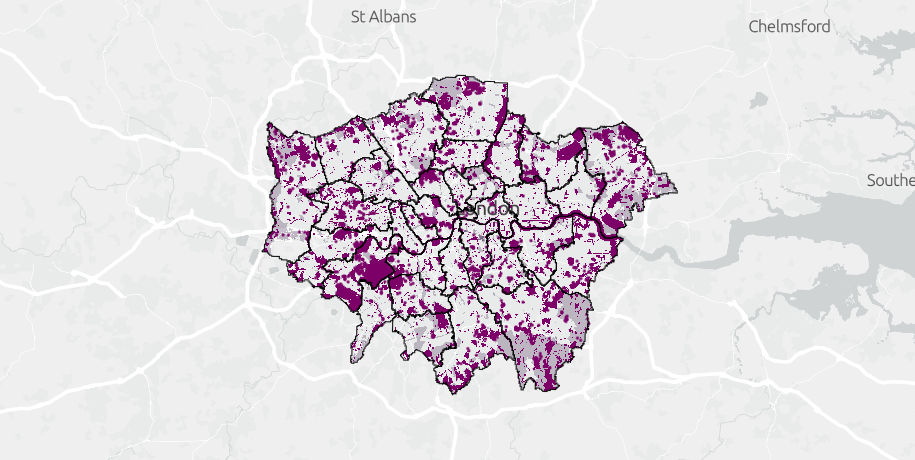
- The London Green Infrastructure Framework (LGIF). The LGIF is a strategic mapping and evidence tool developed by the Greater London Authority. It brings together key London-wide data on green and blue infrastructure, helping identify where investment in parks, trees, sustainable drainage, green corridors, and other green infrastructure can have the greatest impact.
- The London Local Nature Recovery Strategy (LNRS). The LNRS is a city-wide strategy required under the Environment Act 2021. It identifies London’s biodiversity priorities and maps where action is needed to help nature recover and thrive. The strategy sets out both the “what” and the “where” of nature recovery across the capital.
Why it matters
Together, they provide a shared evidence base for improving London’s natural environment. The tools are increasingly referenced in policy and will therefore direct investment in the location and type of green spaces across the capital. By understanding and using them you can help protect and enhance your local Green Belt and parks, more confidently engage with planning applications or work with local authorities to improve their data.
What does the Draft London Plan say?
The Draft Next London Plan builds upon the biodiversity and climate-resilience policies in the current London Plan. Although links are made to the Local Nature Recovery Strategy and London Green Infrastructure Framework, CPRE London has asked for these to be strengthened. Without stronger protections, clearer delivery mechanisms and greater support for implementation, the Plan risks falling short of demonstrating how the significant growth proposed can be achieved while safeguarding and enhancing biodiversity, ecological connectivity, tree cover and access to nature.
Draft policy GHR6: Trees, Biodiversity and Geodiversity brings together Policies G6, G7 and G9 of the current London Plan. It asks plan-makers to prioritise the protection of veteran trees, increase tree canopy and use the LNRS to inform nature recovery. Developments are encouraged to retain existing trees wherever possible, with alternative layouts or construction methods considered before removal. Where removal is unavoidable, replacement planting should reflect the benefits provided by the trees lost.
Although the policy sets out clear principles for assessing individual developments, it must go further by addressing impacts on the wider ecological network. This is where a requirement for cumulative ecological assessment could help to avoid the gradual fragmentation and loss of connected habitats, tree networks and green corridors across multiple developments. Nature does not stop at a site boundary, and planning decisions should therefore be capable of considering the combined effects of development on connected ecological networks. Moreover, new planting and green infrastructure cannot immediately replace the ecological, climate and landscape functions of established woodland, mature trees or species-rich habitats.
To align with national policy, the Plan should require developments to demonstrate how their greening proposals contribute to wider ecological networks, climate resilience and strategic green infrastructure objectives, informed by the London Green Infrastructure Framework and Local Nature Recovery Strategy, rather than treating urban greening as a standalone, site-based exercise. Draft policy GHR7: Green infrastructure and Urban Greening Factor should also recognise that Urban Greening Factor targets alone do not guarantee long-term biodiversity, resilience or public benefit, and therefore should include clear requirements for monitoring, management and maintenance to ensure green infrastructure is delivered, retained and functioning throughout the lifetime of development alongside Biodiversity Net Gain commitments.
There is also a wider question about food growing and food security. The current London Plan contains a dedicated Policy G8: Food Growing, which protects allotments and encourages opportunities for food growing. In the Draft Next London Plan, food growing is not carried forward as a standalone policy within the chapter on creating a greener, healthier and resilient city. Instead, it is referenced more briefly in HN8: Housing Design, and PV6: Metropolitan Open Land. This appears to be a missed opportunity. Food-growing spaces can contribute to several of the Plan’s objectives at once: supporting local food production and food security, providing habitat and biodiversity, improving access to green space, supporting health and wellbeing, and contributing to climate resilience. With the Government’s Land Use Framework highlighting the need to balance competing demands for land, the London Plan should recognise food-growing land as part of London’s wider green infrastructure and resilience network.
Overall, the Draft Next London Plan contains several positive developments for biodiversity and climate resilience. However, the Plan should go further in making retention the starting point for existing natural assets, assessing cumulative impacts across connected ecological networks, and recognising food-growing land as part of London’s environmental and climate-resilience infrastructure. Without these improvements, the draft risks missing the opportunity to secure the strategic, cumulative and lasting environmental benefits needed to support London’s growth, tackle the climate and nature crises, and reduce inequalities in access to high-quality green infrastructure.
You can learn more about how CPRE London responded to the Draft London Plan policies by clicking here. We also recently covered the new draft policy on “Accessible Green Space” here and how the draft Plan puts Green Belt at risk here. To get in touch with us about a local green space under threat, you can reach us at planning@cprelondon.org.uk.