

 Contact us
 Visit CPRE.org
 Donate
Developers in Hounslow avoid brownfield, waiting for Green Belt release

Developers in Hounslow avoid brownfield, waiting for Green Belt release.
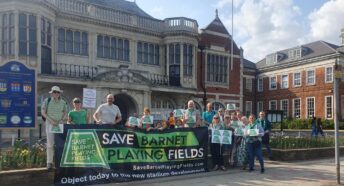
At the end of January 2026, CPRE London attended the Hounslow Local Plan Examination in Public alongside Clare Searle (Friends of Hatton Fields), Rob Gray (Friends of the River Crane Environment or FORCE) and other local groups concerned about the borough’s determination to release Green Belt.
At the hearing, council officers said there had been a lack of interest from developers in re-using or intensifying existing industrial sites, hence they felt there was a need to release Green Belt. But CPRE London, alongside other campaigners, pointed out that this undermines both the regeneration (‘brownfield’) first, and intensification principles embedded in the London Plan and the National Planning Policy Framework.
Essentially, we said, the market has been skewed for 10 years, because the council has signalled potential widescale release of Green Belt. Companies which acquired Green Belt sites near Heathrow Airport cheaply, some years ago, for their ‘hope’ value (i.e. hoping they would be released from Green Belt so planning permission could be obtained) have had no incentive to redevelop existing sites – and every incentive to wait for Green Belt to be released.
Clare Searle pointed to evidence collected by Friends of Hatton Fields showing extensive vacant industrial floor space in the nearby area, something she has written more about in the aftermath of the hearing.
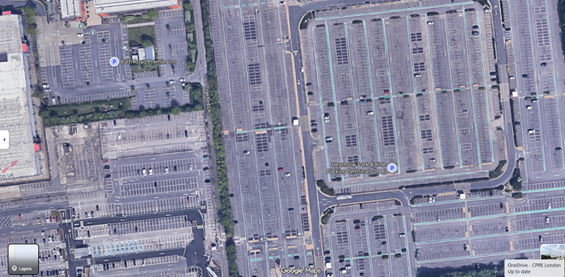
We also raised concerns about the lack of progress on allocating the vast areas of surface car park around Heathrow, which could readily accommodate logistics business linked to the airport, even taking into account flight path safety.
And – perhaps most importantly – we said there has also been no effective assessment of the value of the Green Belt at Hatton Fields and other sites, which makes it impossible to judge the harm which would be wrought by building on them, especially given the very obvious benefits the sites provide – in mitigating the appalling levels of air pollution, the extreme ‘heat-island’, and rain-water run-off issues created by the airport – AND for local people (which the Friends of Hatton Fields will testify to). There is, we said, a very strong case for retaining these areas as natural green space for these reasons alone.
Rob Gray from FORCE set out his concerns:
- The Examination is very process oriented. Whilst this may be inevitable (and helpful in many respects) it can also result in major matters of principle being somewhat lost in the detail. The major principle from our perspective is the proposal to remove large areas of open space from Green Belt protection in order for them to be developed.
- The council appears to accept – and their reports show – that these areas are at least moderately performing with respect to their Green Belt designation. Our contention is further that the council has not sought to explore over the last ten years (either on its own or in partnership with local groups) the true value (actual and potential) of these sites from a biodiversity; public health; climate change and community asset perspective – even though this would be in line with many of its other policies as set out in the Plan.
- Our understanding is that Planning Law would still allow de-designation to be considered if “Exceptional Circumstances” can be proven.
- The council has said that “Exceptional Circumstances” are demonstrated through the SACA. Our understanding is that this is by discussions with developers who say they cannot afford to intensify the use of existing industrial sites. This was also set out by the council’s advisor who said for example that the costs of an intensive use scheme such as X2 could not be justified in the current climate.
- At the same time however both the council and the developers are saying that there is unprecedented demand for this type of land use.
- Why then can’t the normal market forces of supply and demand be allowed to work – and the costs of re-developing and intensifying the use of the large (and often outdated) existing industrial land holdings be justified by the major and unprecedented demand for new logistics units?
- In our view this is not happening because the council has also been proposing the removal (originally of 250 hectares and latterly of 50+ hectares) of land from Green Belt protection for at least ten years. In this context there is no reason for a developer to undertake the costly (and potentially higher risk) process of intensifying use of an existing industrial zone when the potential for all this Green Belt land coming on stream remains so tantalisingly close. Any developer proposing to do this would risk being undercut on cost if and when this Green Belt land became available.
- Two points were made today that underlined this point. Firstly – the council noted that they have made no allowances in the plan for any intensification of existing industrial sites during the whole plan period to 2041. Secondly – the Segro representative noted that they “Don’t see the potential gains from intensification”.
- It was also interesting to hear representatives from two major existing developed sites offering up their sites to the council for change of use to industrial during the morning session. How many more sites might there be out there that could be developed in this fashion?
- In our view this lack of interest in re-use or intensification of existing sites is due to the market being skewed by the potential for large scale Green Belt release. This is entirely at odds with the requirements of the London plan to promote site intensification. The idea that no intensification of existing sites is planned to take place over the next 15 years under this Plan would be a shocking dereliction of planning duties.
- We also note that if the council, through this plan, is allowed to adopt the principle of major Green Belt site release in response to an argument from developers around cost then any protections of the remaining Green Belt (both in Hounslow and across Greater London) would be largely lost. The Hounslow Local Plan would inevitably be used as a precedent for further Green Belt releases – based on the given that Green Belt development is less costly than intensification.
We would be very grateful if this response can be taken into account during the Plan review process. Please advise of a means to better ensure this happens if this submission is not sufficient.