


Large-scale events in London’s parks: why we need better regulations

Local campaigners around London, fed up with their parks being taken over and being used for largescale commercial events, are taking action. At CPRE London, we’re working to propose a simple solution.
Up until 2017, London boroughs mostly stuck to limits set out in legislation which set limitations on the scale of commercial events in parks. But then things changed. What happened? And why are we now calling for the re-introduction of limitations?
London parks and commercial events
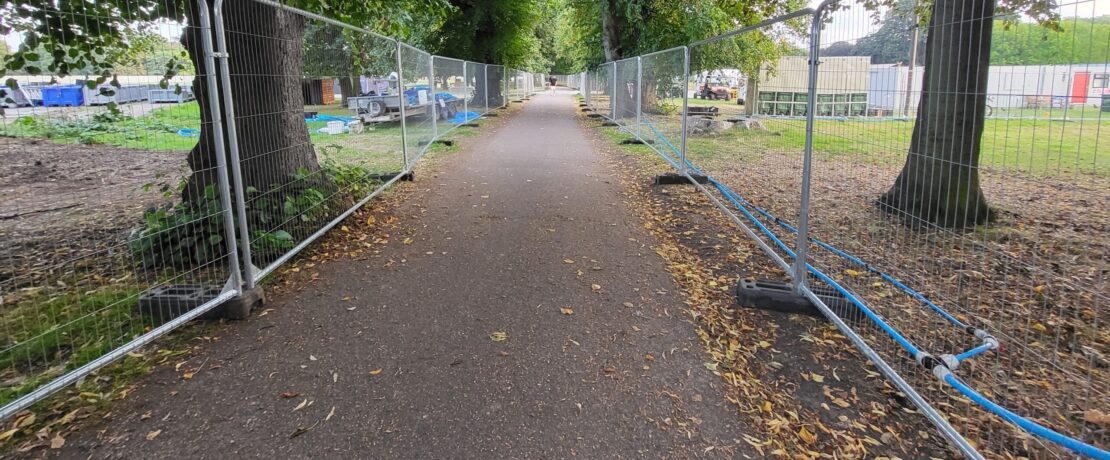
Policy makers and the public are now better informed about the benefits of providing accessible urban green spaces to assist citizens’ health and wellbeing. But London’s parks and green spaces are increasingly used as venues for large-scale, commercial events involving more than 20,000 attendees and there is an inherent conflict between the everyday use of green spaces, and large-scale events, the impact of which is varied, but the key issue is the public’s right to use London’s parks is eroded.
There has been an increase in the size and frequency of events in parks where events were already being held; but there has also been an expansion into other parks, not previously used for big events. Research involving site visits and communications with park users suggests this issue has now reached a tipping point. What was previously happening in isolated parks is now a wider concern that is affecting a significant number of green spaces. The temporal and spatial footprints of large-scale events (i.e. how many weeks they go on for, and how much space they take up) are contested across London: in the North (Finsbury Park); East (Victoria Park); South (Brockwell Park) and West (Gunnersbury Park). The issue is now affecting commons and open spaces too: for example, Clapham Common; Peckham Rye; Streatham Common; & Tooting Common. Tickets for these events are notoriously expensive, putting them out of reach of the majority of citizens. These are now exclusive events staged by global entertainment companies rather than public entertainments. (Read Dan Hancox’s research for more.)
We believe this trend is driven by two things: (1) A 2017 judgement in the Appeal Court meant councils no longer felt bound to adhere to rules which previously governed their activity. (2) Councils increasingly driven by financial pressures are more likely now to take advantage of that judgement.
Why the current regulations are inadequate
The ‘Finsbury Park’ judgement in 2017 confirmed that local authorities have the right to hire out and enclose parks for events under section 145 of the Local Government Act 1972. But it also stated that constraints which councils had been adhering to prior to 2017, do not apply (notably the Greater London Parks and Open Spaces Act 1967 which limited the space which could be used for events to 10% or 1 acre). Effectively, there are now no constraints on how much of a park can be hired out, or for how long. [See Commercialisation of London parks May 2025 – the law.]
In practice this has enabled bigger events at a time when councils are cash-strapped: some openly admit maximising revenue is now the primary motivation for large-scale events. At the same time, lack of constraints in the context of competition between councils makes it hard for them to impose restrictions on the companies running the events.
What needs to happen now
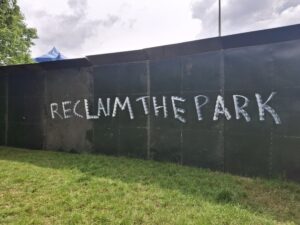
Better regulation is needed to protect public access to parks and green spaces and prevent their over exploitation as commercial event venues. Councils do not own parks, they are the custodians of the public’s right to use them, and they must be provided for the benefit of the public. The expansion of expensive, fenced events undermines the ethos and accessibility of people’s parks. Placing clear constraints would also enable councils to set clear boundaries when negotiating with event companies.
Various efforts have been made to promote self-regulation:
- In 2017 Parks for London negotiated an agreement among London boroughs with as a kind of ‘code of conduct’.
- The University of Westminster’s 2020 report set out recommendations including that London-wide legislation should restricts paid entry events to a maximum amount of park space and park time should be revised and enforced.
However the recommendations are not adhered to. We believe this is because:
- Financial pressures on councils makes it difficult for them to manage what is a conflict of interest for them (custodians of public rights; a duty to balance budgets
- The grey area of what is / is not ‘reasonable’ allows global events companies to apply pressure when negotiating, and leaves councils competing with one another
- Councils are not well equipped to hold events companies to contracts for largescale events e.g. for damage to the park, litter, policing etc
- Councils are delegating to CICs to run events, and thereafter struggle to control the events (parks are then exploited by the CIC)
Measures need to be taken, in our view, to update, restore and enforce key elements of the 1967 Act, notably the temporal and spatial restrictions which provided reasonable measures to ensure commercial events could not dominate London’s parks and green spaces.
- The stipulation in the 1967 Act that events should not take up more than 10% or more than one acre (whichever is larger) of the available open space should be restored and enforced. Prior to the Haringey vs Friends of Finsbury Park rulings (2017), London Boroughs were adhering to this. This simple regulation has multiple benefits; it ensures the majority of park space remains accessible all year round, and it means that large-scale events have to be staged in suitably large parks.
- The stipulation in the 1967 Act regarding the permitted frequency of commercial event hires should be updated so that there is an agreed upper limit on: a) the number of days that local councils and park authorities can hire out parks and green spaces for large-scale events; and b) the number of days that park access can be disrupted by building and dismantling large-scale event venues.
These limits would prevent park authorities over-exploiting individual spaces and provide incentives for authorities to enforce shorter build up / break down phases.
EXAMPLE Tower Hamlets / Victoria Park / AEG
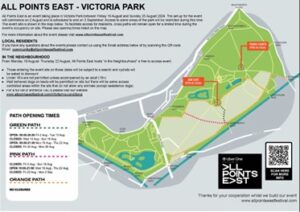
The new contract they have approved in early 2024 means a significant expansion in the number of major event days, potentially doubling them by 2026. The council expects to generate £1.588 million from commercial event activity in 2024, and the rationale for expansion includes the notion that they are competing with other councils and don’t want to lose AEG contract. The event site is well over the 10% of the park areas as you can see from this map. Image showing (the light grey areas) the scale of All Points East event in Victoria Park
EXAMPLE Damage to Finsbury Park. This presentation from Louise Wass of the Friend of Finsbury Park gives an idea of the damage that can be done by major events.