


Climate change and commercialisation: a tough summer for London’s parks

Long days, soaring temperatures, the holiday mood: summer is well and truly upon us, and with it London’s festival season. In fact, urban festivals are rapidly growing in size, scope, and popularity – in 2025, ticketed music festivals ran for a cumulative 140 days, up 60% from 2022.
Many of the companies behind these events are bidding for progressively larger events licenses, as well as introducing new events year by year to meet demand. But this all comes at the expense of one of London’s most vital public resources: its public parks, commons and green spaces.
Local authorities, citing increasing financial pressures, are eager to capitalise on the festival boom. Whilst councils have always been able to rent out park space for commercial events, they used to be subject to stricter spatial and temporal constraints. Though these were lifted in 1972, most London boroughs continued to adhere to them in principle and many enshrined them in local policy. A 2017 judgement in the Appeals Court marked a shift in this mentality, with many councils seeing the space provided by parks as a financial opportunity.
Why is the use of public parks an issue?
Local campaign groups across the capital have differing levels of concern over noise and disruption to the surrounding area, but most are united against the degradation of critical green infrastructure that these large-scale events can cause. As London experiences its hottest year on record, urban green spaces are perhaps more essential than ever. In addition to their benefits to the physical and mental health of the people who use them, urban green spaces can cool their interiors and surroundings by up to 7*C, which plays a significant role in combating the urban heat island effect.
Meanwhile, 1 in 5 households in London have no private garden access at all. Typically, those on the lowest incomes have the least access to mechanical cooling, amplifying the importance of green infrastructure. Public parks provide a great benefit in that they are equally and universally accessible.
Large-scale private events impede upon this access in more ways than one
Enclosure – physically partitioning large portions of parkland – leads to the disruption of access to facilities within. This can include (but is not limited to) cutting off through-routes for active travel and restricting the use of benches, play and exercise equipment. The installation of fences and walls within a public space can also have psychologically negative impacts, that last long after they have been taken down, lingering as “ghost fences” that may make users hesitant to engage with the space. By reducing the amount of space for recreation, the capacity of the park or common shrinks. Furthermore, an area will rarely be enclosed for just the duration of a festival. Installation and dismantling event infrastructure can take weeks, and barriers often stay up during the in-between period of multiple events.
When swathes of parkland are enclosed and the public progressively shut out and unable to engage with their local green spaces and public facilities, the positive effects of these green spaces are lost.
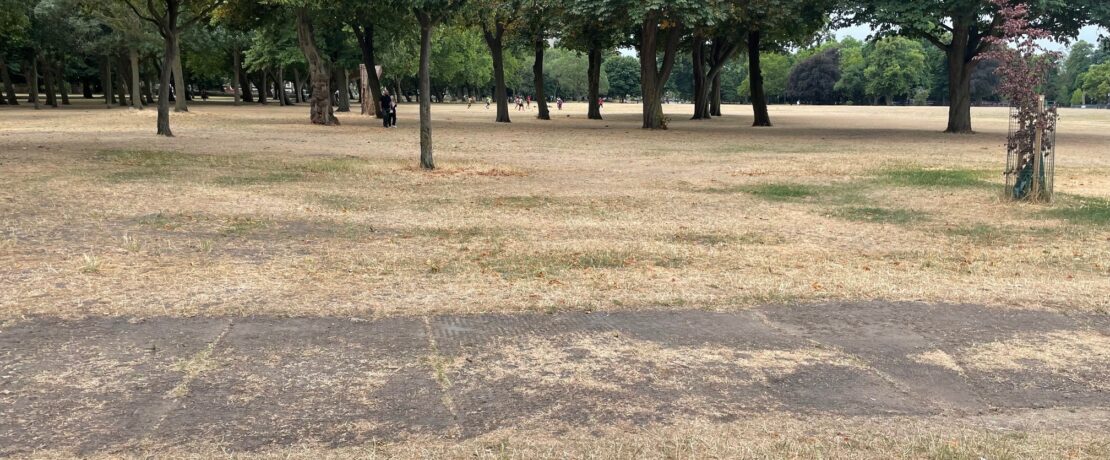
The risk of damage to park environments from commercial events is also a significant concern. Soil compaction and damage to fields and grassland from the footfall of large crowds and the movements of HGVs and food vans across parkland create dusty and dead surfaces, heightened by worsening droughts. This results in an increase in albedo and a decrease in evapotranspiration – the loss of greenery worsens the land’s ability to cool the air around it. These effects will often extend past the barriers, and hit wherever has experienced overcrowding during the festival period. For example, the entryways that are used by all visitors to the park, including those without festival access, who may suffer its ill effects nonetheless. If there is a spell of heavy rain before the grass has had the time to recover, the dry land can become a mud-pit (after which monodominant species of weeds can quickly colonise and prosper).
Mature tree removal by local authorities is also cited as a product of commercial festivals; while the reasons given are usually legitimate (it’s often justified through public safety concerns), the aforementioned soil compaction from intense activity on the ground creates the conditions that legitimise it. HGVs rolling through the park during set-up and take-down crush tree roots and increase the soil density around them, resulting in branches dying and the canopy thinning as root growth and air/water availability are limited. There have also been reports of trees being damaged as branches are removed or impacted to create space for through-routes and festival facilities.
By the time that barriers have come down, parks, commons, and public green spaces have already taken damage that prevents them from being able to provide their myriad of benefits to the general public – many of whom are reliant on them. A loss of trees and the shade they provide represents not only the harm to parks as an ecological asset, but the degradation of London’s vital climate-resilient infrastructure.
The fight against commercialisation
Local campaigns against park commercialisation have made some good ground – most significantly, a major win by Protect Brockwell Park in the High Courts this year found that festivals in the park had unlawfully exceeded the 28-day permitted development threshold. This forces all future applicants to undergo the full planning process, including formally submitting a planning application to the relevant local authority. This major step forwards brings about a greater degree of transparency, and allows for the voices of the communities affected to be acknowledged through local authority planning portals. However, it also calls attention to the real extent of these large events, and how the companies behind them may aim to expand their length and scale into the future.
AEG Presents, who organise All Points East and Lido, have applied to Tower Hamlets Council for planning permission to run their events in Victoria Park for 6 concurrent years, all during peak season. Unbound by the need to stick close to the previous limit, the application seeks “temporary use of Victoria Park for up to 75 days a year for commercial / festival events (including music festivals) and the construction/deconstruction of such festival sites”. The application’s redline boundary encompasses 24.8046ha – almost 30% of the park – and the capacity of events is also set to double, from 20,000 to 50,000.
The events period last year in Victoria Park led to unprecedented damage to the grasslands, to the point where the extended period of recovery has led to the rescheduling of Lido 2026 within the events window. The Protect Victoria Park Campaign, said “we and the vast majority of local residents we have spoken to, are concerned about the destructive impact on the park that has been going on for years unchecked. Ever larger and longer festivals are turning the already too dry ground into concrete, suffocating the roots of our hugely valued mature trees that give Victoria Park its unique character and its visitors much needed respite during heatwaves. Closing such a large area to the non-paying public during the school holidays prevents vital access and puts pressure on the remaining parts of the park that are also under stress.”
As London’s summers get hotter and drier, and winters get warmer and wetter, the most suitable recovery period shrinks and is delayed. With events getting larger and lasting for longer, the damage to the fabric of the parkland increases. This will only continue to put our green infrastructure at risk, pushing London’s parks – critical to its climate resilience – to a tipping point sooner than expected.
What needs to happen now?
As the festival industry continues to grow, London’s critical green infrastructure is being gatekept by commercial events, and being degraded through their damaging setup and operations. Presently, there’s no end in sight, as evidenced by AEG Presents’ bid to expand their festivals in Victoria Park. CPRE London is calling for a change to the law to place spatial and temporal limits on the commercial use of public parks to ensure that public access is protected, along with the physical fabric of the park and the biodiversity it supports.
If you’d like to be kept up to date about CPRE London’s work to protect and enhance London’s green spaces, you can sign up to our newsletter.