


New data out: London still failing to improve recycling rates

New government recycling data for 2024/25 published 31 March 2026 shows London’s recycling rate continues to show no improvement, though it’s a mixed bag for London’s boroughs.
- See our full report here: LB Recycling Scorecard 2026
HIGHLIGHTS
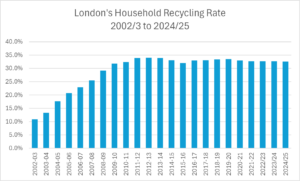
London’s recycling rate (the proportion of waste sent for recycling or composting) dropped from 32.7% to 32.6%, the lowest rate since 2016. Since 2020, the rate has dropped by 0.9% points.
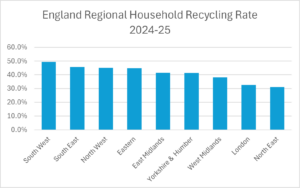
London’s recycling rate remains the second lowest in England, after the North East with 31.1%.
It’s a mixed bag from the boroughs (graphs below):
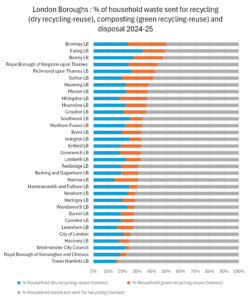
- Congratulations to Bromley, London’s best performing borough, though its rate dipped just below the 50% milestone which it was the first London borough to achieve last year.
- Also a special mention for Ealing with the highest ‘dry’ recycling rate by some distance (this is paper/metal/glass/plastic) AND it has the lowest kg of waste and recycling overall collected per head (more of which below).
- Ealing, Bexley, Kingston, Richmond and Sutton are the next best performing boroughs, all with a rate of over 40%.
- Bromley and Ealing saw slight decreases in their rates, Bexley an increase.
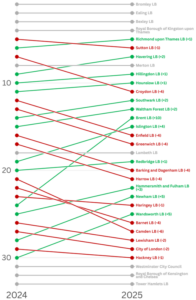
- Brent’s large jump up the rankings puts it back to near where it was in the 2024 scorecard, making last year appear to be something of an anomaly.
- Tower Hamlets is London’s worst performing borough despite seeing an increase of 1.2% points this year.
- Wandsworth climbed out of the bottom four with an impressive increase of 5.1% points.
- Hammersmith & Fulham, Islington, Newham, and Westminster also saw increases of more than 2% points.
- Croydon had the biggest decrease of 3.5% points.
- 11 boroughs have a recycling rate of less than 30%, down from 13 last year.
- Wandsworth and Brent’s increases were the second and third largest seen in England, after Cornwall and five other boroughs were among the top 20 biggest increases in England (Islington, Hammersmith & Fulham, Newham, Westminster and Bexley).
- However, in common with last year, there are no London boroughs in the top 20 local authorities with the highest recycling rates in England
Which boroughs went up in the ranking and which went down?
Chart showing rank order change from 2023/24 to 2024/25.
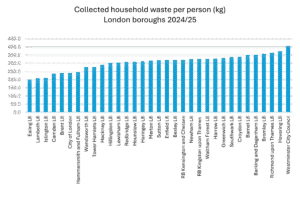
Amount of waste collected per person – some good news.
Many London boroughs collect much less waste (kg per person) overall than other English local authorities.
- This is the total amount of waste collected per person regardless of whether it was sent for recycling, composting or disposal. The lowest rate was 201kg per person in Ealing and the highest 406kg in Westminster.
- Nine of the 20 English local authorities with the lowest kg of household waste collected per person are London boroughs, including all of the six lowest. This is unchanged from last year, see Annex Table 3 in the report.
- City of London and Islington were the English local authorities with the largest decrease in waste collected per person over the previous year, with Ealing, Redbridge and Hackney also in the top 20, see Table 4 in the report.
What should London boroughs do to increase recycling?
Alice Roberts of CPRE London said: “We often hear London boroughs say it’s too hard to increase recycling rates in London. But that – and pardon the pun – is rubbish. Most Londoners have comprehensive recycling services, including food waste collections. These need to be extended to all households which don’t currently have them. But the key is we all need to use our recycling services properly. Better communications are absolutely key. They are needed to make sure everyone knows what they’re required to do, and this needs to be backed up with enforcement action, which is absolutely standard in other countries including Wales which has a very high recycling rate now. This would include putting warning stickers on bags, or issuing fines for persistent non-recyclers. Evidence shows communications and enforcement are vital to lifting recycling rates.
“Ultimately it costs councils – and so us, the taxpayers – more money if we don’t recycle.
“We have been demanding action on London’s embarrassingly low recycling record for years. Every year new data shows no progress in improving London’s poor recycling rate. London continues to languish at the bottom of the table. This isn’t just an environmental disaster, it’s a huge waste of taxpayers’ money. It’s embarrassing and it’s time for action.”
Our report last year set out more detail about how boroughs can improve their recycling rates (read last year’s report here London Boroughs Recycling Scorecard 2025).
Roberts said: “We want boroughs to set a target of 50% of household waste sent for recycling or composting by 2030. Boroughs which already have high recycling rates should set a target of 60% and lead the way to achieving it.”